
Strabismus in Children: Causes, Symptoms and Modern Treatment Options
7 min read · Updated 2026-10-24
A squint is not just a cosmetic matter. When the eyes do not work together, vision in one eye may not develop properly. The good news is that strabismus in children can be assessed and treated very effectively today. This guide explains the causes, how a squint is diagnosed, and the treatment steps – from glasses to surgery when it is the right choice.
What is strabismus?
In strabismus, also called a squint, the two eyes do not point at the same spot at the same time. One eye looks at the target while the other turns away. The brain receives two different images. Adults would see double; children instead learn to ignore the image from the turning eye. If this continues, that eye becomes lazy (amblyopic) and three-dimensional vision does not fully develop.
A squint may be constant or come and go – for example when a child is tired, unwell or looking into the distance. In babies, a broad, flat nasal bridge can make the eyes look crossed when they are actually straight. Our guide to spotting squint in babies explains how to tell the difference in the first months.
The most common types in children
- Esotropia (inward turn): one eye turns towards the nose. It often appears in toddlers and is frequently linked to long-sightedness.
- Exotropia (outward turn): one eye drifts towards the ear, often only intermittently – when tired or looking far away.
- Vertical squint: one eye sits higher or lower than the other; some children tilt their head to compensate.
- Microstrabismus: a very small angle that cannot be seen from outside but can still cause a lazy eye.
- Paralytic squint: rare; caused by a weak eye muscle or nerve, and usually comes on suddenly.
What causes a squint in children?
Often no single cause can be identified, but several factors make strabismus more likely:
- Long-sightedness: the eye has to focus hard to see clearly, and this effort can trigger an inward squint.
- Family history: a parent or sibling with a squint or strong glasses increases the likelihood.
- Premature birth and certain neurological or developmental conditions.
- One eye seeing much less well than the other, for example because of a large refractive error.
- Rarely, eye conditions such as congenital cataract or a disorder of the retina.
Symptoms parents may notice
- One eye visibly turns – all the time or now and then, often most obvious in photos.
- Your child closes one eye in bright sunlight.
- Head tilting or turning to see better.
- Older children describe double or blurred vision.
- Clumsiness when reaching, catching or on stairs, or tiring quickly when reading.
Small squints are often invisible from outside, so an orthoptic assessment is worthwhile even if the eyes look straight but other signs are present. See also early signs of vision problems in children. If a squint appears suddenly, or comes with double vision, headaches or nausea, please contact us the same day.
How strabismus is diagnosed
Orthoptic assessment
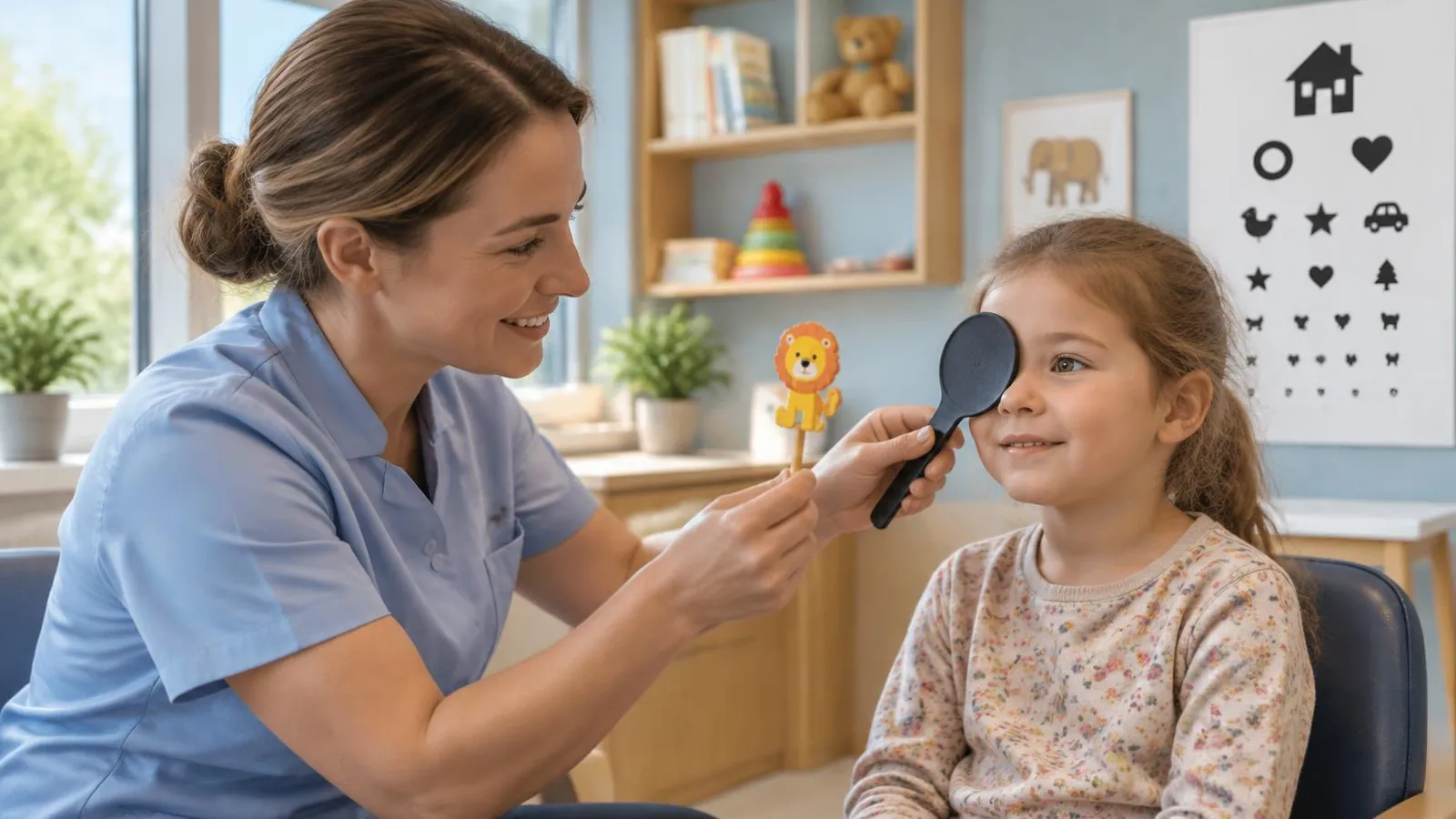
In the cover test, the orthoptist covers one eye at a time while your child looks at a small toy. If the uncovered eye moves to pick up the target, a squint is present. Prisms are used to measure the angle, and the orthoptist also checks eye movements in every direction and depth perception. Find out more in the orthoptic clinic: what to expect.
Measuring the prescription with eye drops
Dilating drops relax the eye's focusing so that any hidden long-sightedness – a common cause of inward squint – is fully revealed.
Ophthalmic examination
The ophthalmologist examines the front of the eye, the retina and the optic nerve to make sure no eye disease lies behind the squint. If the squint started suddenly or comes with other symptoms, we arrange further tests where needed, for example with a paediatric neurologist.
Modern treatment, step by step
Treatment has three aims: good vision in each eye, eyes that are as straight as possible and, where achievable, both eyes working together in 3D. The steps needed depend on the type of squint and your child's age.
Step 1: the right glasses
Any refractive error is corrected first. In an inward squint caused by long-sightedness, glasses alone can greatly reduce or even fully correct the squint – as long as they are worn all day. Our guide to children's glasses has practical tips.
Step 2: treating a lazy eye
If the squinting eye sees less well, the stronger eye is patched for part of the day or temporarily blurred with special eye drops. How many hours and for how long is decided individually and reviewed at every visit. Read more about amblyopia.
Prisms and exercises in selected cases
Prism lenses can help with certain types of squint or double vision. Orthoptic exercises are mainly useful when the eyes struggle to work together at near; exercises alone usually cannot straighten a constant squint.
Squint surgery when it makes sense
If a significant angle remains despite glasses and orthoptic treatment, surgery may be recommended. The outer eye muscles are repositioned or tightened on the surface of the eye; the eye itself is not opened. In children the operation is performed under general anaesthetic and usually without a long hospital stay. In selected cases, an injection of botulinum toxin into an eye muscle may be an alternative.
Surgery does not replace glasses or lazy-eye treatment; both usually continue afterwards, and occasionally a second operation is needed. We discuss with you whether and when surgery is appropriate and look after your child before and after the procedure.
Why early treatment matters
Children do not usually grow out of a squint. The earlier treatment starts, the better the affected eye can develop while the visual system is still adaptable, and the better the chances of 3D vision. Straight eyes also matter for many children's confidence.
Practical tips during treatment
- Schedule patching time around favourite activities such as drawing, puzzles or story time.
- Praise your child and track progress together, for example with a sticker chart.
- Let playgroup, nursery or school know about the glasses and patch.
- Make sure the glasses fit well and have bent frames adjusted promptly.
- Keep every follow-up appointment – treatment is adjusted as your child progresses.
Frequently asked questions
Will my child grow out of a squint?
After the first few months of life, usually not. A squint that persists or appears later should always be assessed by a paediatric eye specialist so that a lazy eye does not develop.
At what age can strabismus be treated?
Assessment and treatment are possible from babyhood. Glasses and patching start as soon as the diagnosis is clear; the timing of any surgery is decided individually.
Can glasses cure a squint?
In an inward squint caused by long-sightedness, glasses can correct the squint while they are worn. For other types they are usually an important part of treatment, but not the whole of it.
How long will my child need to wear a patch?
This varies a lot and depends on age, how weak the eye is and how quickly it improves. The patching plan is reviewed at every orthoptic visit.
Is squint surgery safe for children?
It is a common, well-established operation on the outer eye muscles. As with any surgery there are risks, which the ophthalmologist and surgical team will explain in detail beforehand.
Is treatment covered by Swiss health insurance?
Medically necessary examinations and treatment by the ophthalmologist and in the orthoptic clinic are covered by Swiss basic insurance (Grundversicherung). Your deductible and co-payment depend on your policy.