
Amblyopia: spotting a lazy eye early
6 min read · Updated 2026-08-18
In amblyopia one eye is healthy but still sees poorly, because the brain has learned to ignore its image. About three in a hundred children are affected – and almost none of them notice.
How a lazy eye develops
Vision is learned in the first years of life. For the visual pathway to develop normally, each eye must deliver a sharp image. If one eye constantly delivers a blurred or deviating image, the brain suppresses it and the corresponding connections stay underdeveloped.
- Squint: the image of the deviating eye is suppressed.
- Different prescriptions in the two eyes (anisometropia) – the most common and least visible cause.
- Strong long- or short-sightedness and marked astigmatism in both eyes.
- Obstacles to vision such as a drooping eyelid, congenital cataract or corneal opacity.
Why it is so often missed
A child with a one-sided lazy eye sees normally with the good eye and behaves entirely normally. There is no complaint, because with both eyes open the impression is sharp. Vision tests performed with both eyes open also come out normal.
This is why testing each eye separately is essential – it is the only way a difference between the eyes becomes visible. It is also why we recommend a check at the age of two to three even when nothing seems wrong.
Observations that point to amblyopia
- The child protests when one particular eye is covered.
- The head is tilted or the child moves very close to things.
- One eye deviates, even only occasionally.
- Uncertainty on stairs, with ball games or when reaching for objects.
- Squint, amblyopia or strong prescriptions run in the family.
Assessment at the practice
Visual acuity is tested for each eye separately, together with the cover test, an assessment of three-dimensional vision and a refraction after dilating drops. The medical examination excludes causes such as cataract or retinal disease. Only then is it clear which form of amblyopia is present and how it should be treated.
Treatment: glasses first, then patching
Full correction of the refractive error with accurately fitted children's glasses always comes first. In many children this alone improves vision markedly over weeks to months.
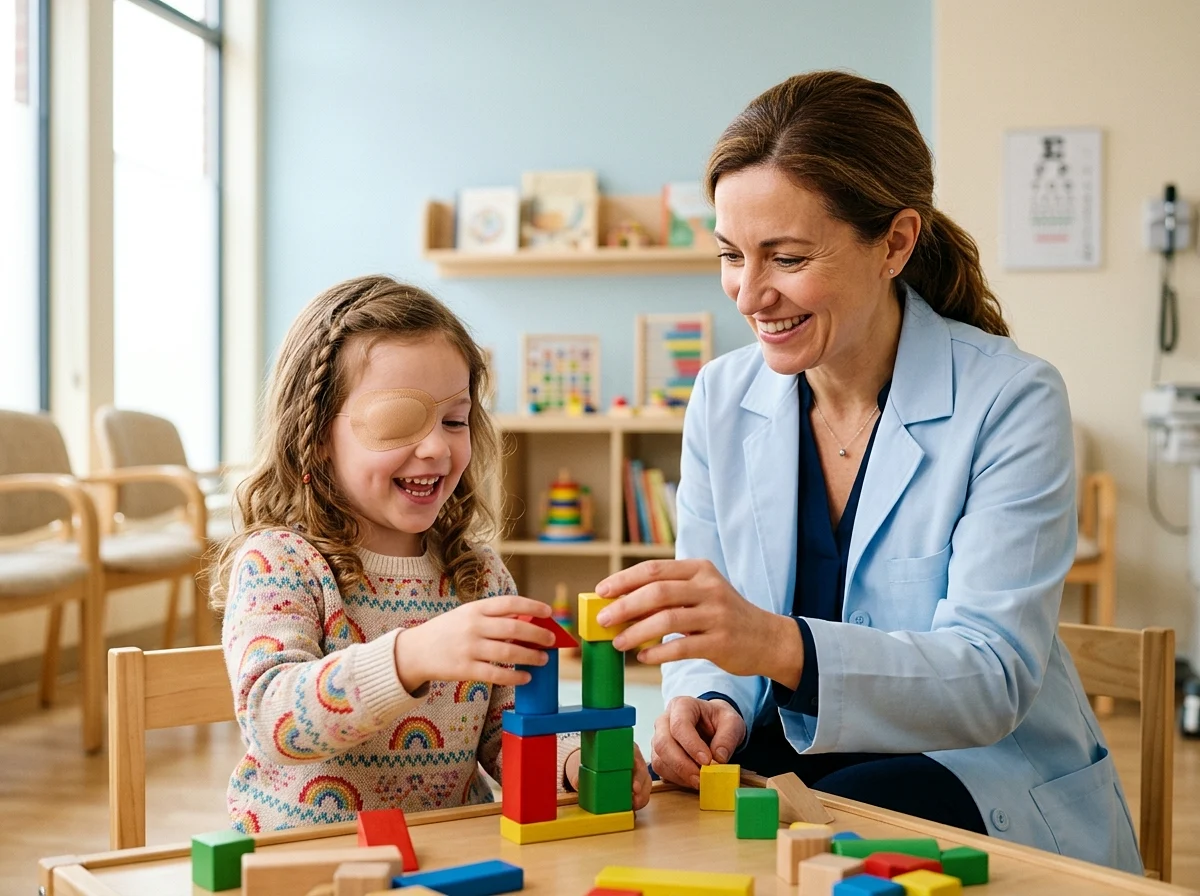
If that is not enough, the better eye is patched for a number of hours a day so the weaker eye has to work. The number of hours depends on age and severity and is reviewed regularly at the orthoptic clinic. Alternatively, drops can temporarily blur the better eye.
Consistency matters most: the treatment only works if it is kept up in everyday life. A sticker calendar, fixed times and attractive activities during patching help far more than reminders.
How long does treatment take?
Usually months to years, with regular checks. Once good vision is reached, a maintenance phase with reduced patching keeps the result stable. Treatment started before school entry has the best outlook; from around the age of eight further progress is limited.
Frequently asked questions
Can amblyopia be treated in adults?
Only to a very limited degree. The visual pathway is largely mature from around the age of eight. Glasses then sharpen the image, but the weakness anchored in the brain usually remains.
Does my child have to patch all day?
No. A specific number of hours per day is prescribed depending on age and severity, and it is adjusted at each follow-up.
Can glasses alone cure a lazy eye?
Often yes, particularly when different prescriptions are the cause. Patching is added only if vision with glasses does not improve sufficiently.