
Spotting squint in babies
7 min read · Updated 2026-08-18
A squint is not a cosmetic issue. When the eyes do not work together, the brain suppresses the image from the deviating eye and that eye stays weak. The earlier a squint is found, the better this can be prevented.
What is a squint (strabismus)?
In a squint the two eyes do not point in the same direction. One eye fixes on the target while the other drifts inwards, outwards, up or down. The brain receives two different images and suppresses the one from the deviating eye. That eye is used less and less and develops a lazy eye (amblyopia).
A squint affects around five in a hundred children. It can be present at birth, appear in the toddler years, or result from uncorrected long-sightedness. Sometimes an eye or eye-muscle disease is behind it – another reason why every noticeable squint should be assessed.
When is a squint no longer normal?
In the first weeks of life occasional drifting eye movements are normal because eye control is still maturing. From the fourth month, however, the eyes should stay stably aligned.
As a rule of thumb: any squint still present after the third month should be examined. A squint that appears suddenly – at any age – needs immediate assessment, as does a squint together with double vision, a head tilt or vomiting.
Signs parents should know
- One eye drifts inwards or outwards, especially when the child is tired or concentrating.
- The baby fixes on you with only one eye or protests when that eye is covered.
- The head is constantly tilted or turned to one side.
- In flash photos the light reflex is not in the same spot in both pupils.
- The child often closes one eye outdoors.
- Older children complain about double or blurred vision.
The light reflex test at home
You can gather a first clue at home. Sit opposite your child and shine a small torch on the bridge of the nose from about half a metre while the child looks at the light. The small bright dot should sit in exactly the same position in both pupils, typically just inside the centre.
If the reflex is clearly displaced in one eye, that suggests a squint. The test does not replace an examination: small angles, so-called microsquint, cannot be seen this way yet can still cause marked amblyopia.
Pseudo-squint: when it only looks like one
Many babies look cross-eyed even though the eyes are perfectly aligned. The reason is a wide bridge of the nose with prominent skin folds that cover the inner white of the eye. This pseudo-squint disappears as the face grows.
From the outside, a true squint cannot be reliably told apart from a pseudo-squint, not even with the light reflex alone. Only an orthoptic examination with the cover test gives certainty. It is harmless, takes a few minutes and removes the uncertainty.
How we assess a squint
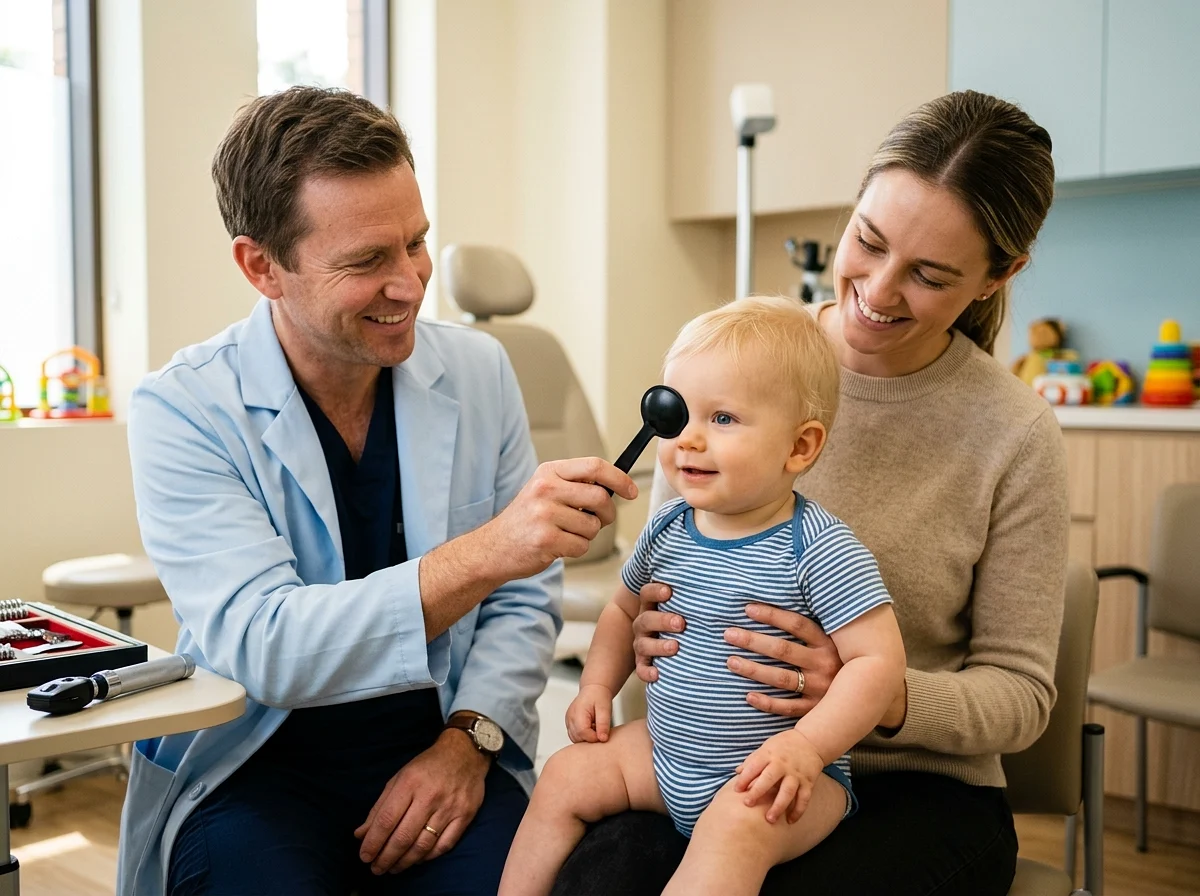
At the orthoptic clinic our orthoptist checks eye alignment with the cover test, measures the angle of the squint, assesses eye movements and three-dimensional vision. Afterwards, dilating drops allow the exact refraction to be measured and the retina to be examined so that underlying disease can be excluded.
Treatment: glasses, patching, surgery
Correcting the refractive error comes first. Many forms of inward squint largely disappear once the child wears the right glasses.
If a lazy eye has already developed, the better eye is patched for a set number of hours a day or slowed with drops so the weaker eye has to work. Follow-ups at the orthoptic clinic determine how much patching is needed.
If a disturbing angle remains, eye-muscle surgery can correct the alignment. It is usually planned only once glasses and patching have been exhausted and the vision in both eyes is stable.
Frequently asked questions
Will a squint grow out by itself?
A true squint does not grow out. Only pseudo-squint, where wide skin folds imitate a squint, disappears as the face grows. That is why any noticeable squint after the third month should be examined.
Can a baby squint without it being visible?
Yes. In microsquint the angle is so small that it is invisible from the outside, yet the affected eye can still become markedly amblyopic. It is only detected with the orthoptic cover test.
Up to what age is treatment successful?
Treatment works best in the first years of life while visual development is still flexible, roughly until the age of eight. After that an established lazy eye can only be improved to a limited degree.