
When should my child see an eye doctor?
6 min read · Updated 2026-08-18
Children almost never say that they see poorly – they have no comparison. That is why the timing of the first eye examination has a real influence on how well vision develops. Here are the recommended ages, the warning signs that matter and what happens at our practice in Glattpark (Opfikon).
Recommended ages at a glance
Visual development remains flexible until roughly the age of eight. What the brain does not learn during that window can hardly be made up later. This is why there are clear time frames for an eye check, even for children with no obvious problems.
- First weeks of life: after premature birth, or if squint, strong refractive errors or eye disease run in the family.
- 6 to 12 months: if you notice anything about eye alignment, gaze behaviour or the pupils.
- 2 to 3 years: the first complete eye examination for every child, even without symptoms.
- Before kindergarten or school: a check of visual acuity, binocular vision and refraction.
- Immediately, at any age: sudden squint, a white pupil, wobbling eyes, injury or rapid loss of vision.
Warning signs in babies and toddlers
Very young children cannot describe what they see, so your everyday observations matter. Contact us if you notice any of the following – the assessment is painless and does not take long.
- One eye turns inwards or outwards, constantly or repeatedly.
- The child tilts or turns the head noticeably to look at something.
- The eyes wobble or do not follow an object smoothly.
- One eyelid droops lower than the other and covers the pupil.
- In photos only one pupil glows red, the other looks whitish or grey.
- Constantly watering, sticky or unusually light-sensitive eyes.
Warning signs in kindergarten and school children
In older children, vision problems usually show up in behaviour rather than in complaints about the eyes. Concentration or reading difficulties are often suspected first, even though the cause lies in the eyes.
- Sitting very close to books, exercise books or screens.
- Screwing up the eyes, frequent blinking or eye rubbing.
- Headaches or burning eyes after reading and homework.
- Losing the line while reading, twisting or skipping letters.
- Difficulty copying from the whiteboard.
- Clumsiness with ball games or when judging distances.
What happens at the first examination
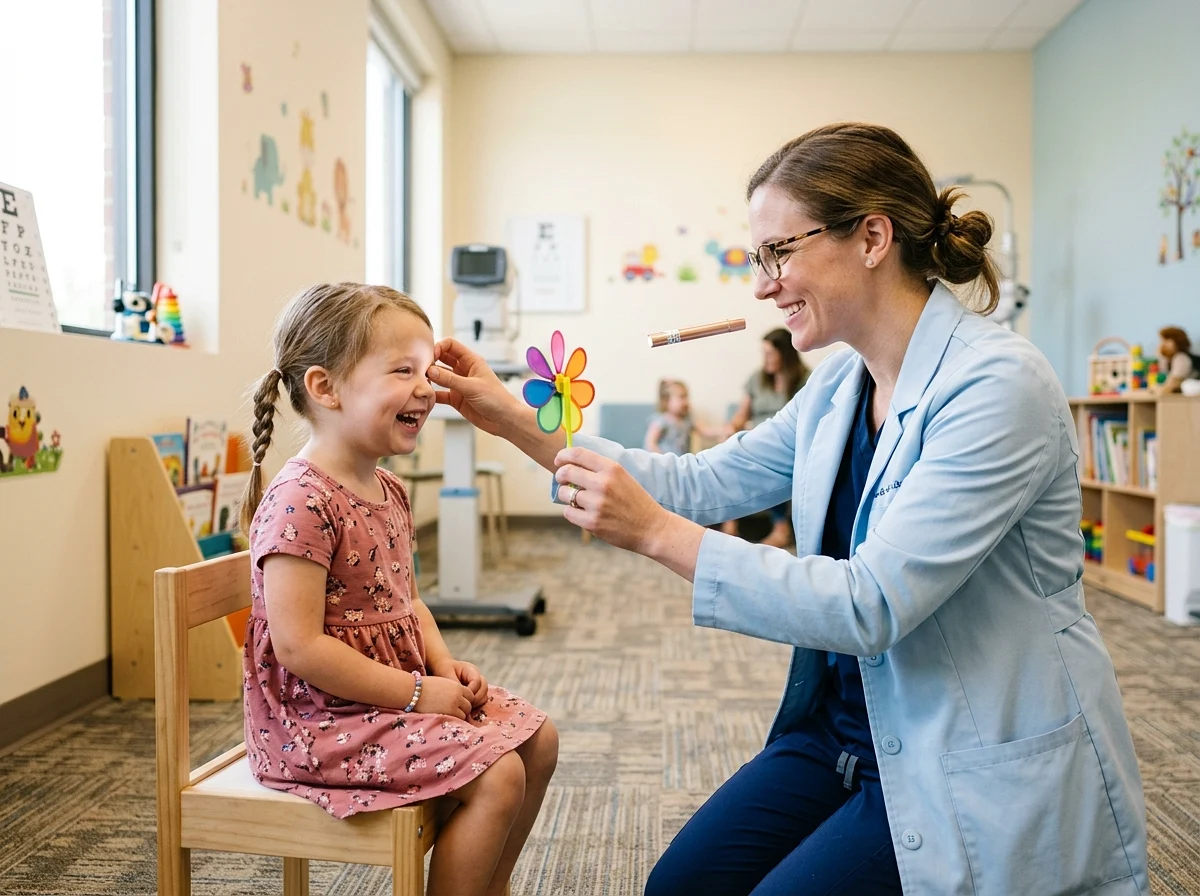
A complete children's eye examination takes 45 to 90 minutes depending on age. We explain every step in child-friendly language and give your child time – none of it hurts.
The appointment includes an age-appropriate vision test, an orthoptic assessment of eye alignment, eye movements and three-dimensional vision, a contact-free measurement of the refraction – for the youngest children with the Plusoptix paediatric autorefractor from about one metre away – and the medical examination of the front of the eye and the retina.
Dilating eye drops are often required. They widen the pupil and temporarily switch off focusing, which is the only reliable way to measure a child's glasses prescription. Afterwards your child will see blurred up close and be light-sensitive for a few hours, so bring sunglasses and a cap and keep the afternoon calm.
How to prepare for the appointment
- Bring the insurance card, any referral and previous reports.
- Do not forget current glasses or contact lenses.
- A favourite toy helps younger children settle.
- Choose a time when your child is rested – not right before a nap.
- Allow enough time so nothing feels rushed.
Frequently asked questions
How young can a child see an eye doctor?
From the first month of life. The examination is adapted to the age and works for babies who cannot speak yet – vision and refraction are measured playfully and without contact.
Do we need a referral from the paediatrician?
No. You can contact us directly. A referral or a paediatrician's report is welcome but is not required for an appointment.
Does health insurance cover the examination?
Yes. Eye examinations and the orthoptic clinic are covered by Swiss basic health insurance and billed according to Tarmed.