
Early Signs of Vision Problems in Children: What Parents Should Know
7 min read · Updated 2026-10-24
Children rarely tell us they cannot see well – a blurred world is simply normal to them. That is why parents are often the first to notice that something is not quite right. This guide explains how vision develops, which early signs of vision problems in children to look out for, and how we assess and treat them at our paediatric eye practice in Glattpark (Opfikon), just outside Zurich.
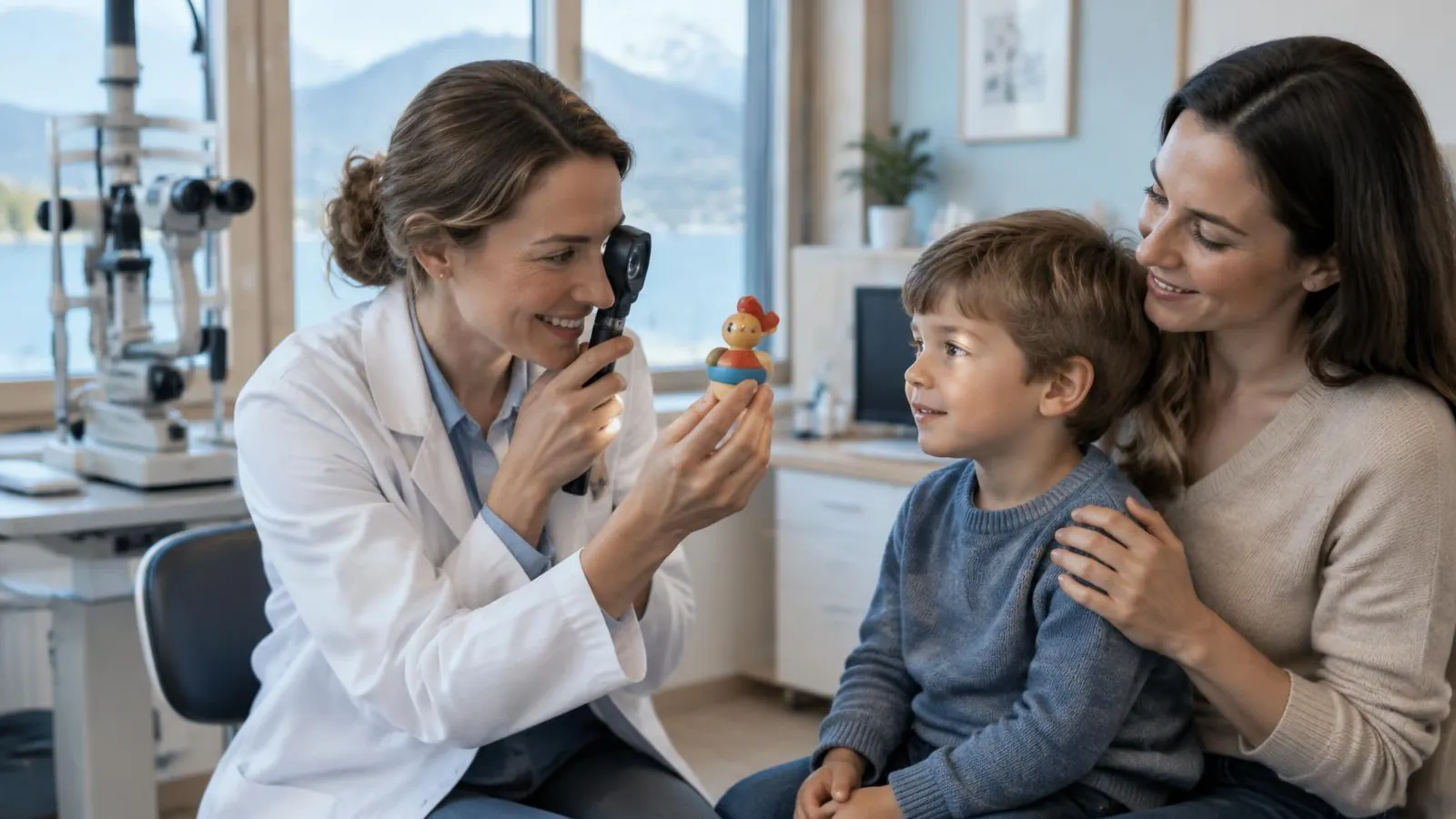
Why children rarely notice a vision problem themselves
A child has nothing to compare with. If their sight has always been blurred, they assume everyone sees that way. If only one eye is affected, the other eye quietly takes over, so everyday life looks completely normal. This is why many childhood vision problems go unnoticed until a proper eye test.
"Vision problem" covers several conditions: a refractive error such as long-sightedness, short-sightedness or astigmatism, a squint, a lazy eye (amblyopia) or, less often, an eye disease. Most of these respond well to treatment – provided they are picked up in time.
How children's vision develops
Children are not born with mature vision; they learn to see during the first years of life. The eyes and the brain develop together, and the visual pathways only mature normally when both eyes send a clear, matching image.
The first months
Newborns mainly see outlines and strong contrasts at close range. Over the first weeks and months a baby learns to fix on a face and follow moving objects, and the two eyes start to work as a team. A brief, occasional drift of one eye can be normal in the first weeks; if it is still present after the first few months, a paediatric eye check is advisable.
Toddlers and pre-school children
Sharpness of vision keeps improving for several years and depth perception becomes more refined. An undetected refractive error or squint is particularly disruptive at this stage, because the brain learns to ignore the weaker image.
Why the early years matter most
The visual system stays adaptable until roughly the age of eight. During this window amblyopia (lazy eye) usually responds well to treatment; later, results are far more limited. Early detection therefore gives your child the best chance of good vision in both eyes.
Early warning signs parents can look out for
No single sign proves a vision problem, but anything you notice repeatedly is worth checking. Short notes or a phone video can be very helpful at the appointment.
Babies and toddlers
- One eye turns in, out, up or down – all the time or now and then.
- Your baby rarely fixes on faces or toys, or does not follow them smoothly.
- The eyes wobble or flicker from side to side.
- An upper eyelid droops far enough to cover part of the pupil.
- Your child protests strongly when one particular eye is covered.
- The head is often tilted or turned to look at something.
Pre-school and school-age children
- Squinting, sitting very close to the TV or holding books close to the face.
- Frequent eye rubbing, lots of blinking, or closing one eye when reading or in bright light.
- Headaches, tired or sore eyes after reading, drawing or homework.
- Losing their place when reading, mixing up similar letters or avoiding close work.
- Seeming clumsier than other children with ball games, stairs or pouring.
- The teacher mentions difficulty copying from the board.
Signs that need prompt attention
- A white or greyish pupil – even if you only notice it on a flash photo.
- A squint or double vision that appears suddenly.
- New, unexplained wobbling of the eyes.
- Rapid loss of vision, an eye injury, or a red, painful eye that is sensitive to light.
In these situations please call the practice the same day or, outside opening hours, contact the ophthalmic emergency service.
Common causes of poor vision in children
- Long-sightedness (hyperopia): mild long-sightedness is normal in young children. Higher levels force the eye to focus constantly, which is tiring and can trigger an inward squint.
- Astigmatism: lines and letters look distorted at both near and distance.
- Short-sightedness (myopia): distant objects look blurred. It often starts at school age and can progress – see our guide to myopia in children.
- Unequal prescriptions between the eyes (anisometropia): hard to spot in daily life and a frequent cause of lazy eye.
- Squint (strabismus): the eyes do not point in the same direction. Causes and treatment are covered in strabismus in children.
- Less common causes: congenital cataract, a drooping eyelid, or conditions of the retina or optic nerve.
What happens at a children's eye examination
A paediatric eye examination is painless and tailored to your child's age. Even babies and children who cannot yet talk can be examined reliably. Please allow around 45 to 90 minutes.
An age-appropriate vision test
Young children name pictures or simple shapes; older children read numbers or letters. Each eye is tested separately so that a problem in one eye is not missed.
Measuring the prescription
Our Plusoptix paediatric refractometer measures contact-free from about one metre away. For an accurate result we often use dilating eye drops: they relax the eye's focusing so that hidden long-sightedness shows up. Afterwards your child will be sensitive to light and have blurred near vision for a few hours.
Orthoptic assessment
Our orthoptist checks eye alignment, eye movements and depth perception, which also reveals small squints that cannot be seen from outside. Read more in the orthoptic clinic: what to expect.
Examining the front and back of the eye
Finally, the ophthalmologist examines the cornea, lens, retina and optic nerve. We explain every finding in plain language and agree the next steps with you.
Modern treatment options
Treatment depends on the cause. Often a few well-coordinated steps are enough, reviewed and adjusted at regular follow-up visits.
Well-fitted glasses
Accurately prescribed glasses give the retina a sharp image and are often the single most important step. Our guide to children's glasses explains what matters for frames and lenses.
Patching or eye drops for a lazy eye
If one eye still sees less well with glasses, the stronger eye is covered with a patch for part of the day, or temporarily blurred with special eye drops. This makes the weaker eye work harder so it can catch up.
Slowing myopia
For progressive short-sightedness, low-dose atropine eye drops and specially designed spectacle or contact lenses can slow the progression. We decide together whether this is right for your child.
Everyday tips for parents
- Keep up with routine check-ups at your paediatrician, where the eyes are screened as well.
- Mention any family history of squint, strong glasses or eye disease – it is a reason to have your child's eyes tested earlier.
- Give your child time outdoors every day; daylight and looking into the distance are considered good for developing eyes.
- Build regular breaks into screen time and reading.
- If something looks unusual, do not wait to see whether your child grows out of it – an eye test gives you certainty.
When to book an appointment
If you notice any of the signs above, we recommend an examination soon. Even without symptoms, a first full eye examination at around two to three years of age and another check before kindergarten or school are worthwhile. For an overview of the recommended ages, see when should my child see an eye doctor?.
Frequently asked questions
How early can vision problems be detected in children?
From babyhood. Refractive errors, squint and eye conditions can be identified with contact-free measurements and playful tests, even before a child can talk.
Is the eye screening at my paediatrician enough?
Routine screening is an important first filter. If it shows an abnormal result, if you notice warning signs at home or if eye conditions run in the family, a full paediatric eye examination including a prescription check is recommended.
Can a child grow out of a vision problem?
Mild long-sightedness often decreases with growth. A squint, a significant refractive error or a lazy eye usually does not resolve on its own and should be treated.
Are the eye drops used during the examination unpleasant?
They may sting briefly. Afterwards your child will be sensitive to light and have blurred near vision for a few hours, so sunglasses or a cap for the journey home are useful.
Do screens cause vision problems?
Lots of close work and little time outdoors are linked with progression of short-sightedness, so regular breaks and daily outdoor time make sense. Screens do not cause other conditions such as squint.