Myopia in children: how to spot and control it
7 min read · Updated 2026-09-20
If your child can no longer see the classroom board clearly or moves closer to books and screens, myopia may be the reason. An early examination establishes the correct prescription and whether the eye is growing quickly enough for myopia control to be considered.
What is myopia in children?
Myopia, or short-sightedness, makes distant objects look blurred while near vision is usually clear. In most cases the eyeball is too long for its focusing power, so the image comes into focus in front of the retina rather than on it.
The common form often begins at school age and may increase while a child grows. Glasses or contact lenses provide clear vision. If myopia is progressing, measures designed to slow further eye growth may also be considered.
Common signs in everyday life
- Difficulty reading the classroom board or moving closer to a screen.
- Screwing up the eyes to see more clearly at a distance.
- Recognising faces, bus numbers or balls later than other children.
- Headaches or tired eyes after school and close work.
- A change in school performance because distant information is missed.
- One or both parents are short-sighted, which raises the child's risk.
Why an early eye examination matters
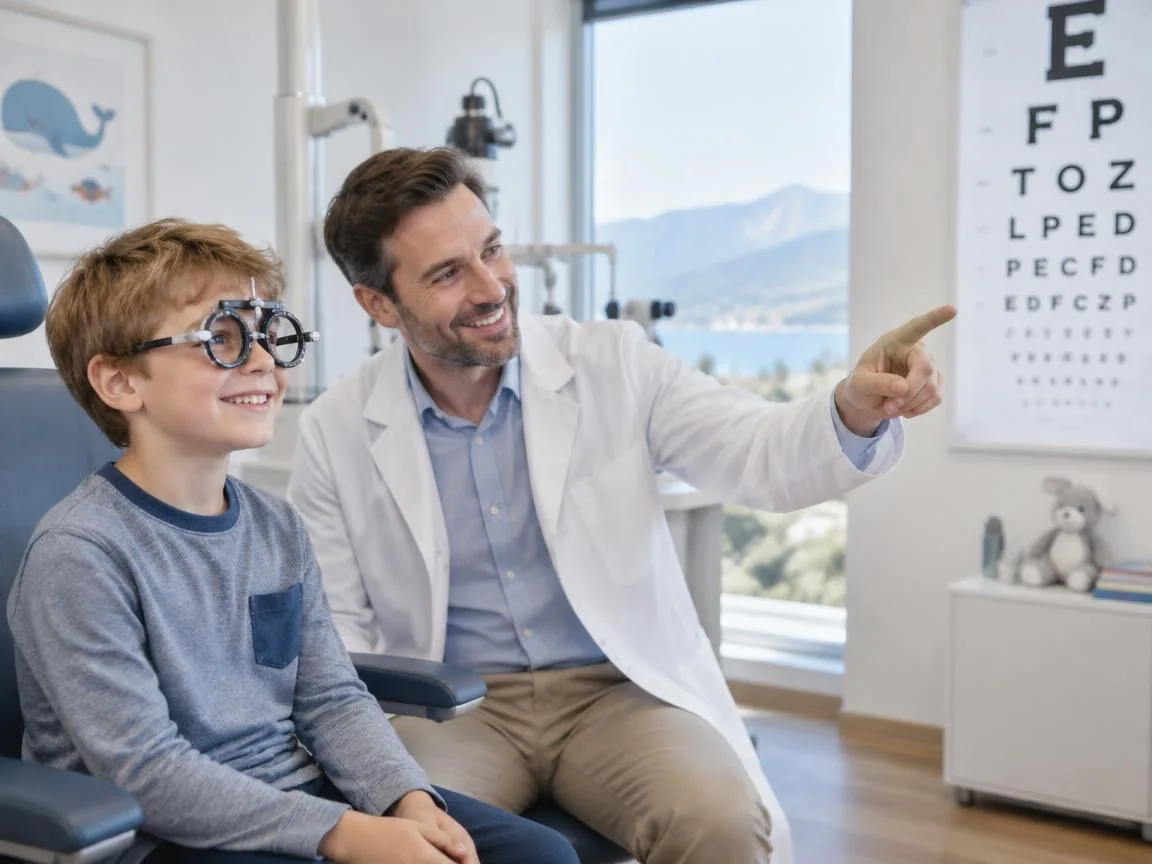
Myopia cannot be diagnosed reliably from posture or behaviour alone. We test each eye separately and measure the prescription. Eye drops may temporarily relax a child's strong focusing system so that the result is accurate.
The earlier myopia begins and the faster it progresses, the higher the final prescription may become. Regular checks allow changes to be recognised and the next steps to be tailored to the child.
What parents can do
Alongside family history, daylight and visual habits matter. Children should spend time outdoors every day. Good lighting, a comfortable working distance and regular breaks looking into the distance help during homework, reading and screen use.
- Aim for around two hours outdoors each day.
- Keep books and screens at a sensible distance.
- Break up prolonged near work by standing up and looking far away.
- Provide good lighting at the desk.
- Attend agreed follow-ups even if the current glasses still seem adequate.
Options for myopia control
For progressive myopia, specially designed spectacle lenses, particular contact lenses or low-dose atropine eye drops may be considered depending on age, measurements and daily life. The aim is not to cure existing myopia but to slow its further increase as much as possible.
The suitable approach is discussed after a complete examination. Effect, tolerance and eye growth require regular review; there is no single treatment that suits every child.
When should my child see an eye doctor?
Arrange a check if your child sees poorly at a distance, frequently squints, or myopia runs in the family. Seek prompt assessment if vision changes suddenly, pain occurs or only one eye appears to be affected.
Frequently asked questions
Can childhood myopia disappear?
True myopia does not usually disappear. Glasses or contact lenses correct it, while an appropriate myopia-control treatment may help slow further progression.
Do phones and screens cause myopia?
No single device is solely responsible. However, prolonged close work, short viewing distances and too little time outdoors are modifiable risk factors. Regular breaks and daily daylight are therefore sensible.
How often should myopia be checked?
The interval depends on age, prescription and progression. With increasing myopia, checks around every six months are often useful; the eye doctor will set the right schedule individually.