Children's glasses: what parents should know
5 min read · Updated 2026-08-18
Children's glasses do more than sharpen vision – they are often the most important treatment for squint and lazy eye. To work, they must be measured accurately, fitted well and actually worn.
When children need glasses
Children are naturally slightly long-sighted; this is normal and needs no correction. Glasses are required when the refractive error affects vision or visual development.
- Marked long-sightedness, particularly combined with an inward squint.
- Short-sightedness that limits seeing the whiteboard or outdoors.
- Astigmatism causing blurred and distorted vision.
- Clearly different values in the two eyes – even without symptoms, because a lazy eye may otherwise develop.
Why the prescription is measured with drops
Children can focus their lens very strongly and thereby mask long-sightedness. Without drops the measured prescription is regularly too weak.
The drops switch off focusing for a few hours. Only then does the measurement show the true prescription – the basis for glasses that genuinely support visual development.
Choosing the right frame
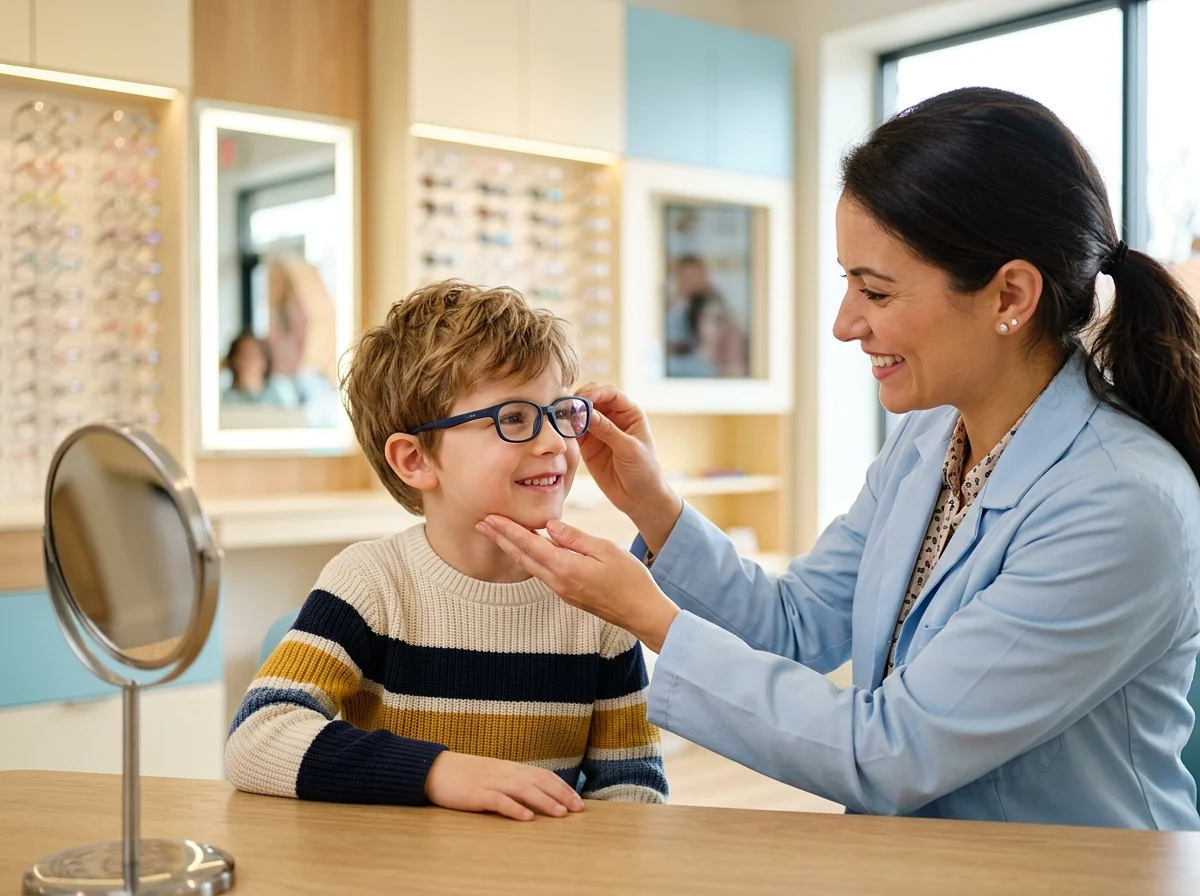
- The top rim should sit at eyebrow level and the eyes should be centred in the lenses.
- The frame must not slide down the nose or press behind the ears.
- Spring hinges and flexible plastics survive everyday life.
- For toddlers, a soft head strap or curved temples keep the glasses in place.
- Let your child help choose – glasses that are liked are glasses that get worn.
The right lenses
Shatter-resistant plastic lenses made of polycarbonate or Trivex are standard for children. An anti-reflective coating improves vision under artificial light and on screens, and a hard coating protects against scratches. UV protection makes sense for outdoor sport, and dedicated sports glasses for school sport.
Helping your child wear them
- Be consistent from day one: glasses go on in the morning, not only for reading.
- In the first days, combine short calm wearing periods with enjoyable activities.
- Keep a fixed place for glasses and case at home and in the school bag.
- Have the fit readjusted by the optician every few months.
- Do not clean with clothing – a microfibre cloth and water are enough.
Costs and follow-ups
Up to the age of 18, Swiss basic health insurance contributes to spectacle lenses within the statutory limits, provided there is a medical prescription. Values change as children grow, so annual checks are usually appropriate – more often with squint or amblyopia.
Frequently asked questions
Do glasses make eyes worse?
No. Glasses do not change the eye, they only correct the image. Prescriptions increase during growth because of how the eye develops, not because of wearing glasses.
From what age are contact lenses possible?
For medical reasons even in infancy; for everyday use typically from around twelve, once the child manages handling and hygiene reliably.
How often should the glasses be checked?
Usually once a year, more often with squint, amblyopia or rapidly changing values. The fit should also be checked by the optician every few months.